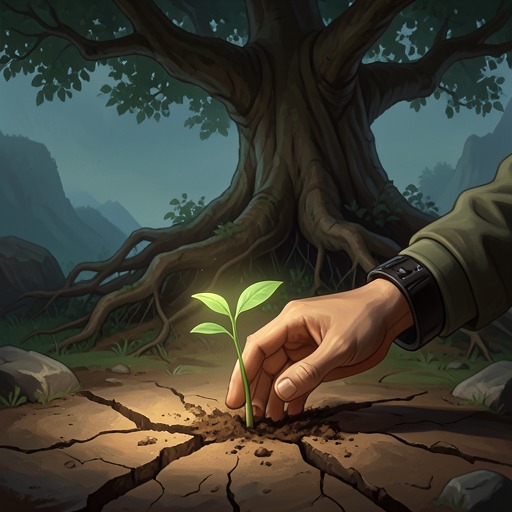
Sow to yourself righteousness
Don't Leave God Alone: How to Get God's Attention, Remain in His Presence, and Even Change His Mind to Make a Difference in Your WorldSow to yourself righteousness is a practical doctrine of moral and spiritual formation. It treats every decision as a seed: right living, right thinking, right attitudes, and right choices gradually produce the lasting fruit of a life aligned with God. The principle rejects both superficial reform and despair, joining disciplined action to forgiveness, prayer, and the expectation that genuine change can become visible.
Definition and Spiritual Logic
The phrase is drawn from Hosea 10:12 and is presented as a continual decision rather than a single emotional moment. To sow righteousness to oneself means making small choices each day that move a person toward what is right. Because the book describes the kingdom as operating through sowing, each act of obedience becomes an investment whose results may develop gradually but can ultimately reshape character and conduct.
This framework places daily practice between desire and transformation. Many people want to please God yet continue stumbling over the same failures; the book attributes lasting change not simply to good intentions but to repeated decisions and discipline. The desired harvest is not a temporary appearance of improvement but a life that increasingly resembles Jesus Christ in thought, attitude, and behavior.
Repentance Rather Than Repeated Apology
The principle distinguishes genuine repentance from sorrow that leaves conduct unchanged. The author recounts struggling with an attitude toward another believer and repeatedly apologizing without surrendering control or forming a permanent intention to change. In that account, God differentiates between saying, "I'm sorry again," and saying, "Lord, I repent." The first expresses regret while leaving open the possibility of repeating the sin; the second signifies rejection of the sin and a complete change of direction.
This distinction gives the seed metaphor an ethical force. Repentance is not proved by the intensity of an apology but by the fruit that follows it. John the Baptist’s call to bring forth fruits worthy of repentance is therefore interpreted as a promise as well as a demand: lasting fruit begins with seeds, and the seeds are the concrete choices made after conviction. A person may fail repeatedly and still return to God, but returning must lead toward changed practice rather than a cycle of remorse without reform.
Roots, Discipline, and the Old Nature
The book develops the principle through an autobiographical gardening image. As a child, the author and his brother were paid to pull weeds from a rocky hillside. They initially removed only the visible tops, filling boxes quickly, but their father’s employer asked, "Where are the roots?" Because the roots remained, the weeds grew back, and the shortcut produced exhausting repetition. Spiritually, superficial change has the same weakness: unless a person addresses the source of a problem, the unwanted pattern returns.
The image of roots also clarifies why daily choices matter. Weeds must be removed before flowers can be planted; likewise, decisions that reach the heart’s underlying habits prepare a life for abundant fruit. The process can involve repeated failure and repentance, but it is not satisfied with doing the bare minimum or managing appearances.
The doctrine is connected to the conflict between the old nature and the new nature. In the book’s account, being born again makes a person a new creature in Christ, while the person still lives in a sinful, mortal body. The nature that becomes dominant is the one that receives nourishment. Appetite for fleshly things strengthens the old nature, whereas the Word of God, worship, and prayer strengthen the new nature. Walking in the Spirit, seeing the old nature as dead, putting on Christ’s ways, and starving the flesh are therefore described as practical forms of sowing righteousness.
Prayer, Forgiveness, and Change in Private
Sowing righteousness does not replace dependence on God. The book repeatedly joins moral effort to prayer and worship, presenting God’s presence as the place where change begins and continues. When people sin or compromise, they may hide behind a symbolic fig leaf—an attempt to justify themselves through their own works. Yet the remedy is not concealment. Because of the blood of Jesus, a person who has failed is urged to run toward God, ask for help, and return to prayer rather than withdraw in shame.
Forgiveness is part of this return. The teaching on prayer insists that people should not allow sin to separate them from God and should approach Him with confidence while cultivating forgiveness toward others. Such forgiveness does not excuse continued wrongdoing; it creates the relational and spiritual ground from which repentance can become honest and sustained.
The most revealing test of the principle occurs when no one else is watching. The book says that character is shown not only before a crowd but also in solitude, where temptation may exploit unguarded habits. David’s decision to remain behind when kings went to battle is used as an example of how an apparently private choice opened the way to his sin with Bathsheba. By contrast, the reader is urged to make right choices when only God is watching, because private obedience plants the seeds from which public integrity grows.
From Healing to a New Way of Life
Blind Bartimaeus provides the book’s clearest picture of a decisive seed choice. His movement from darkness into sight began when he cried out to Jesus and continued until he received his healing. The miracle was not treated as the end of change. Once Bartimaeus could see, he could no longer remain in the identity and circumstances of a blind beggar; his occupation, clothing, skills, and standard of living would all have to be reconsidered. The new condition required a new way of life.
The same pattern is applied to spiritual transformation. Those who once walked in spiritual darkness are expected to live according to the light of God’s kingdom. Change may not appear immediately, and the book warns against both unbelief and impatience: some people do not expect change at all, while others expect instant results and become discouraged when transformation takes time. The proposed answer is daily participation in the process—choosing righteousness today, then choosing it again tomorrow.
The image of Lazarus’s graveclothes extends this idea to resurrected dreams. Even after Lazarus came out of the tomb, he remained bound at the hands, feet, and face until Jesus commanded others to loose him and let him go. In the book’s application, revived dreams can likewise remain restricted by old habits and mind-sets. Bound hands represent limitations on service and work; bound feet represent habits and sins that cause a person to fall; and bound face represents impaired vision, speech, hearing, and thought. A dream’s resurrection is therefore only a beginning. The graveclothes must be removed through renewed patterns of living.
Expected Harvest and Narrative Significance
Sow to yourself righteousness turns transformation into an active, cumulative practice. It offers neither self-righteousness nor passive waiting: a person cannot hide behind fig leaves or merely request change while preserving the roots of the old pattern. At the same time, failure does not require permanent withdrawal from God. The cycle is confession, repentance, daily seed decisions, nourishment of the new nature, and visible fruit.
The principle also belongs to the book’s larger promise that one person’s persistent response can alter circumstances. The book claims that Moses changed God’s mind, that Elijah’s persistent prayer produced miraculous results, and that Bartimaeus’s refusal to stop crying out led to healing. Within that theology, righteous choices are not private moral decorations; they prepare a person to pray, obey, resist temptation, and carry God’s power into the lives of others. The harvest is thus a changed self, but also a capacity to serve, minister, and help bring change to the present generation.